Make your own free website on Tripod.com
Dog Postures good & bad dogs
manners

Keep in mind when you read any or all of this and/or apply it that ignorance or stupidity on your part does not constitute responsibility on my part.

I hope this is beneficial to some of you and gives pause for thought to others. This is based on Dr. Stanley Coren's observations from The Intelligence of Dogs with some modifications to reflect more current research.

IF YOU READ NOTHING ELSE ON MY SITE, READ THIS!!

As a general rule there are 7 main postures that dogs use to communicate:
1. The Play Posture.
This is characterized by the dogs front end being down and his back side being up. The tail is erect and most likely waging. The ears will likewise be erect and the dogs mouth may be open with his tongue exposed.
2. Relaxed Posture
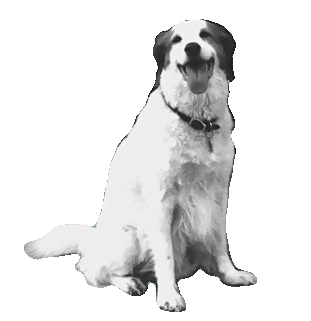
This is indicated by the ears up and relaxed (not forward) and the tail down and relaxed. The mouth may again be slightly opened with the tongue exposed.
3. Alert Posture
This is seen in the ears being up and forward, the mouth being closed and the tail being held straight out but not bristled. The legs are tense and the dog leans slightly forward. You may also observe the dog raising and lowering his head. This may indicate an unsure submissiveness with the lowering of the head and curious alertness trying to catch sight and/or scent of the intruder. Be sensitive to this dog's posture and approach slowly if you must approach at all.
4. Aggressive Posture
The most obvious trait in this posture is the bristling hair most noticable in the shoulder area and the tail which will be raised. On closer inspection (take my word for it and don't approach this dog) the hair is raised all over the body. The dog's nose is wrinkled in this posture and the teeth are bared. The dog's ears are raised and forward and his stance will be slightly forward. The dog will probably be barking or growling but may not be. This is usually a distance increasing posture meaning he would like something to go away as he feels trapped and he has no other option but confrontation.
DO NOT APPROACH THIS DOG! TURN SLIGHTLY SIDEWAYS TO THE DOG BACK AWAY SLOWLY WITHOUT LOOKING THE DOG IN THE EYES. EYE CONTACT MAY BE CONSIDERED A THREAT.
5. Defensive Posture
Just like people, no matter who you are or how you act there will be someone who doesn't like you.
This is seen in the dog's body being lowered, the ears back and the tail between the legs. The most obvious trait in this dog is also the hair being raised. When a dogs hair is on end he should be avoided at all cost. This dog can turn to aggression in an instant in an effort to protect itself.
6. Scared Posture
Looking at this dog you will notice the dog may not look directly at you for very long if at all, the body is lowered, the ears are back and the tail is down, again in an effort to make himself look as small and unopposing as possible. The dog make lick you and the corners of the mouth are back. The dog may also raise a paw. This is not always a trick the dog has learned, I believe it may be a submissive gesture as an approximation (the first step) to rolling over into a fully submissive posture.
7. Submissive Posture
This is the most obvious because the dog will be on his back or side with the top legs raised exposing his belly and throat. This dog too will avoid eye contact, the tail will be between the legs, the corners of the mouth pulled back and ears and hair will be down and back. Dogs identify themselves by scent and to identify himself there may be an expulsion of urine. If you have a dog that does this, don't scold him because it tells the dog there is actually something to be afraid of and may encourage the behavior. You should have a well behaved dog but the dog should feel confident and relaxed around you.


Want to e-mail me about something you've read? You can reach me here.